

By MAGGIE MCMURRAY
Moapa Valley Progress
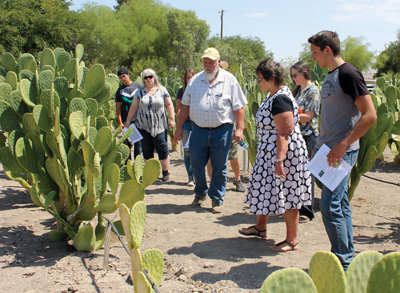
The sight of prickly pear cactus is nothing new to residents of Moapa Valley. However, very few residents realize that these sometimes gigantic common stands of cactus may, in fact, be one of the valley’s greatest resources.
Prickly pear cactus, more commonly known as Opuntia to distinguish it from other varieties of cactus, has been touted by the scientific community as a “wonder fruit” and a hope for the future for biofuel, livestock forage and fodder, and even human consumption.
The local cooperative extension office, which was developed as an agricultural experiment station in 1909, but has had no experiments running since the early 1970’s, is currently being used for a 5-year experiment in raising Opuntia in the local soil and climate.
The experiment, which is a little over 3 years into a 5 year projected run, is being administered by Dr. John Cushman, professor of biochemistry and molecular biology for the University Nevada, Reno. Cushman was the 2013 recipient of the University Researcher of the Year award, as well as the 2017 Regents Researcher of the Year for the state of Nevada.
“When Dr. Cushman came to me and suggested we do an ag experiment on the ag experiment station, I was thrilled,” said local Extension Educator Carol Bishop.
The large experiment garden is located behind the main Cooperative Extension building and is always open for self-guided tours along with a map to view the different varieties of Opuntia planted there.
Last week, Cushman came to the garden for the annual fruit harvest. While there, he gave a workshop on Opuntia: how to grow it, and its uses and advantages.
Cushman began his lecture with maps and data supporting global warming trends, increased carbon dioxide levels in the atmosphere and the projected effects these trends will have on current crops. As worldwide water usage rises and water table levels continue to drop, much research has already begun on drought tolerant crops that are more water efficient and may be used to feed and support the world’s population in the future.
Agriculture is naturally the single largest consumer of the world’s freshwater resources. “Over 1400 sources agree that with the projected 10-12 degree rise in global temperature in the next century, there will be a projected drop in yield production of about 50% for wheat, maize, barley, sorghum, rice, and soybeans,” Cushman said.
Cushman emphasized a need to develop crops that are more water efficient. Many studies are currently being done on plants like gumweed and rabbitbrush for jet fuel, camelina and tansy for oil, and agave and opuntia for biofuel such as ethanol. Cushman explained that agave-derived ethanol is proving to be superior to that of corn, switchgrass, and sugarcane on much less water.
“By developing Opuntia and other CAM crops, the world can produce 100% of its biofuel needs on only 15% of the land, freeing up the rest for other food crops,” he said. “We need to be converting our agave to ethanol and eating our corn. I hope for our sake the switch takes place sooner rather than later.”
Plants such as agave and opuntia are called CAM plants because of the way they respirate. They use much less water, tolerate higher percentages of carbon dioxide in the atmosphere, and are tolerant to high UV levels. These, in addition to their nutritive qualities, make them the stars of the future.
Opuntia provides 100% of the dietary needs of goats and about 40% of the needs of cattle when offered as a forage or fodder. The animals also do not seem to be bothered by the prickly glochids that plague humans. The high water content of the cactus cladodes, also known as pads, means that animals fed on them require very little additional water. Also the fruits and pads are both tasty to humans and high in vitamins, sugars, and water.
The ag experiment is being conducted using 3 different varieties of Opuntia raised with three different watering schemes. The three varieties chosen were ficus-indica, cochenillifera, and streptacantha. In addition, agave tequilana, which is grown and used extensively in Mexico, was also planted.
Unfortunately, the agave tequilana all succumbed to cold temperatures in the first year of the experiment, proving that this area is too cold for that plant. It was replanted with agave americana.
The three varieties of Opuntia, however, have flourished. Cushman said streptacantha has been a little problematic because it is very brittle and is therefore the most prone to wind damage. Due to the frequent high winds in this area, he does not recommend it. Of the other two varieties in the experimental garden, so far ficus-indica has outperformed cochenillifera in most areas, making it the variety of choice for this climate and area.
Cushman is excited about the discoveries being made about Opuntia and the hope it brings for the future. He was pleased with the large turnout for his lecture.
“It’s important for the local community to know what we’re doing from a standpoint of research as well as for changing local agricultural habits and providing opportunities for the future,” Cushman said. “There is so much potential for this crop and using it to spawn cottage industries in this area.”
Cushman offered to provide stock anyone interested in planting Opuntia to get started with. More information can be obtained by calling the cooperative extension office at 702-397-2604.
Bishop is also excited about the experiment and the success it has shown. “This experiment has been a win-win-win situation,” she said. “We are advancing scientific knowledge, learning so we can offer producers alternatives in times of drought, along with less costly means of feeding animals, all while being able to employ and train local youth in conservation.”
Paul Taylor, from Littlefield, AZ, travelled all the way to Logandale for the lecture. “I was interested in coming because I grew up eating the fruit and the pad, but haven’t had a lot of luck growing my own here,” he said. “I learned I have been using the wrong variety. I need to get a variety that is more flavorful and works better with our climate and soil. I learned a lot and it was time well spent.
Class attendee Laura Staley agreed. “I heard Dr. Cushman was very interesting to listen to so I came,” she said. “I had no idea cactus could be used as forage and fodder for goats and cattle. I especially loved the section on plant DNA sequencing. It was fascinating.”
Bishop concluded, “We are constantly offering classes at cooperative extension. We have several every month. This year’s focus is on food production and preservation. Classes are free.
For a list of upcoming classes, you can like the cooperative extension on Facebook, follow their blog, or just stop by the local office for a flier, Bishop said.
“We’d love to have everyone in the community that’s interested in these topics come and participate,” she said.