

By BRYNNE MCMURRAY
Moapa Valley Progress
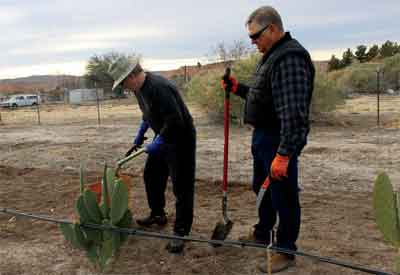
Behind the University of Nevada Cooperative Extension Office in Logandale is a remarkable research project. In a unique garden spot, professors are investigating the biofuel and other properties of the prickly pear cactus.
The project, by UNR professor John C. Cushman and PhD student Jesse Mayer, was started two years ago. It consists of monitoring the growth of 252 cacti of different varieties and weighing them before determining the usability of the crop for biofuel, biomass, feed stock, and human consumption.
The cactus garden is located behind the Cooperative Extension (UNCE) office in Logandale. It is cared for throughout the year by local UNR employees who are paid from a grant specifically for the cactus study.
The garden consists of three types of cacti: Opuntia Streptacantha, Opuntia Ficus Indica, and Nopalea Cochillefera. The three types are separated into three blocks in each row consisting of 21 cacti, or seven of each type per row.
The cacti are also receiving different watering regimes. Since Nevada on average receives 108 mm of rain water every year, the cacti are further separated by row into groups receiving 200mm, 400mm, and 800mm of water a year.
The research team visits the garden once a year to harvest some of the cacti and record the garden’s growth. The process of harvesting the plants consists of separating and counting each pad on the harvested cacti and placing them in paper bags to be weighed. Each harvested plant is replaced with another cactus from the on-site nursery. The bags are weighed “wet,” or still full of water, on site.
The cacti are then transported to Reno where they are dried in an oven to be weighed again for a “dry” weight so that the research team can assess the cacti’s true mass and potential.
The trick is to keep the cacti at the same weight while transporting them. “We have to be careful,” Jesse Mayer explained, “In the past, we have actually had the cacti start growing inside of the bag.”
The cacti in the garden aren’t just growing a little. The growth that the cacti in the study have shown over the past year has surprised even the researchers. Some cacti grew from small plants of only five pads to towering bushes consisting of over 30 pads; all within the space of a year.
“The growth blew us away,” Jesse Mayer commented.
So why base the project in Moapa Valley?
“It’s warmer down here than in Reno,” John Cushman said. “We can’t grow this many cacti up in the north where it is colder.”
The project is in the second year of what is anticipated to be a five year study and it is already showing promising results.
“Similar tests have been run in other countries,” John Cushman explained. “But the results were spotty. We are running this experiment under strict supervision and taking detailed accounts to have reliable information. This is the first definitive study of this kind in the country. We are really excited and encouraged by the results so far.”
The growth of cacti not harvested for weight studies is also carefully monitored. Growth is determined by the number of pads on each plant. The cactus pads are the big leaf-like structures. Pads are sometimes hard to count because they grow exponentially, with each pad producing several more pads. To be completely accurate, the pads are meticulously counted three or four times to be sure of the number of pads on each plant.
The team will take the harvested cacti back to the lab in Reno to run more tests. They are looking forward to seeing how much the garden will grow during the next year.
“This is an agricultural experiment station and since I have been here this is the first experiment we have been able to run,” said local Cooperative Extension agent, Carol Bishop. “We have had an ag experiment station here since 1906. But this is first experiment in many years, so we are very excited.”